Quick answer: in 2026, a single AI workflow or website chat agent typically costs ₹40,000–1,00,000 to build. Multi-step agents connected to your CRM, payments or internal systems run ₹1,50,000–6,00,000, depending on integration depth. On top of the build, expect running costs — model usage, messaging fees and hosting — plus a monthly retainer if you want the thing tuned rather than left to drift.
“How much does AI automation cost?” is now the question we hear more than any other — and it is usually asked the wrong way round. AI automation is not a product with a price tag. It is a build whose cost is set almost entirely by one thing: how many systems it has to touch.
An agent that answers questions from a PDF of your services is a weekend of work. An agent that qualifies a lead, checks your calendar, books the slot, writes it to your CRM and sends a WhatsApp confirmation is a different project by an order of magnitude — even though both look like “a chatbot” from the outside.
The four price bands
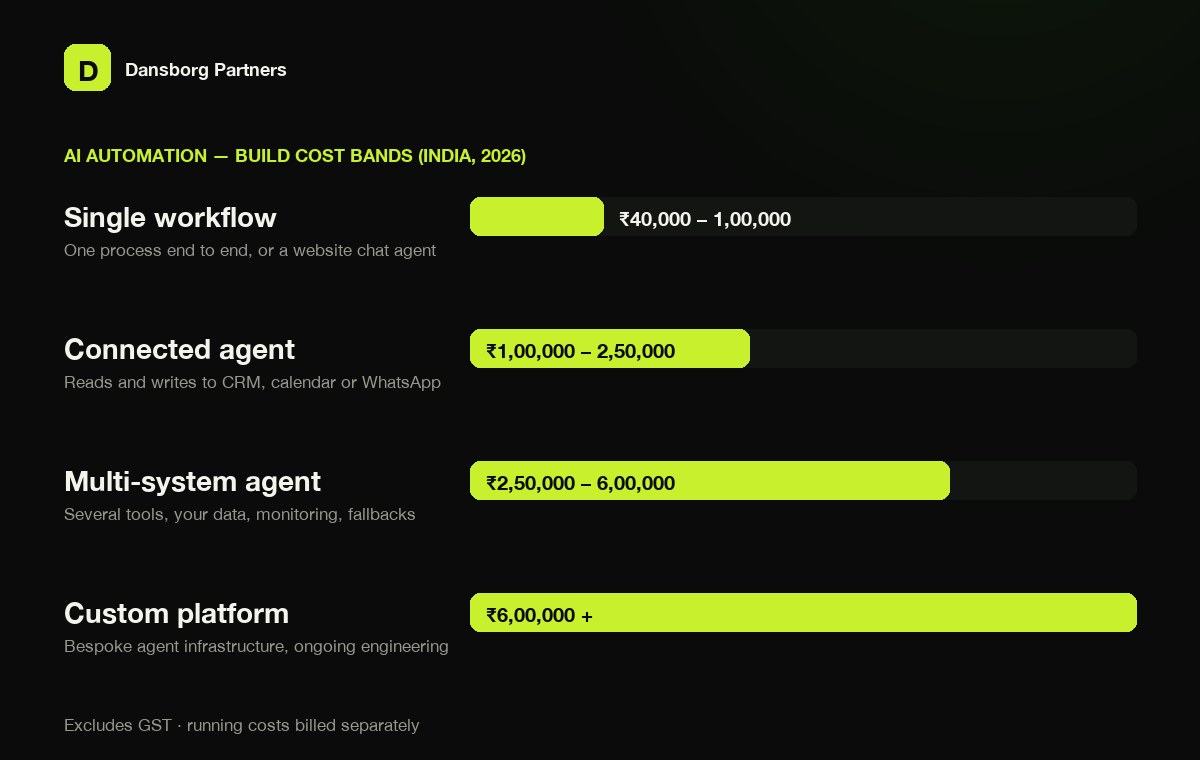
| Tier | Typical build cost | What you get | Right for |
|---|---|---|---|
| Single workflow | ₹40,000–1,00,000 | One automated process end to end — enquiry auto-response, lead routing, report generation, or a website chat agent answering from your own content. | Testing whether AI actually helps before committing budget. |
| Connected agent | ₹1,00,000–2,50,000 | An agent that reads and writes to one or two external systems — CRM, calendar, or WhatsApp Business — with qualification logic and human escalation. | Businesses with real enquiry volume losing time to first-response. |
| Multi-system agent | ₹2,50,000–6,00,000 | Several connected tools, custom logic, your own data as a knowledge base, role-based access, monitoring and fallback paths. | Automating a core operational process, not an edge case. |
| Custom platform | ₹6,00,000+ | Bespoke agent infrastructure, multiple agents, internal tooling, ongoing engineering. | Companies where automation is the product. |
Prices exclude GST. As with web development, the spread between two quotes for the “same” project usually comes down to process and integration depth, not location.
What actually drives the price
- Number of systems it touches. The single biggest cost driver, and it is not linear. Each integration adds authentication, error handling, rate limits, edge cases and testing.
- Whether it reads your data or just talks. An agent answering accurately from your own documents needs a retrieval layer — and needs your content organised first. Messy source material is the most common reason an AI project runs over.
- How wrong it is allowed to be. An agent quoting prices to prospects needs guardrails, refusal behaviour and adversarial testing. That is where cheap builds cut corners.
- Whether a human is in the loop. Fully autonomous is usually more expensive, because everything a human would have caught now has to be handled in code.
- Who builds it. A freelancer wiring no-code tools is cheapest and will get you something working. Whether it still works in six months, when an API changes, is the question worth asking.
The running costs nobody quotes
The build is a one-time number. These are not:
| Cost | Typical range | Notes |
|---|---|---|
| Model / LLM usage | ₹2,000–25,000/mo | Scales with conversation volume and context size. A verbose agent costs multiples of a terse one. |
| WhatsApp Business API | Per conversation | Billed by Meta. India is among the cheaper markets, but rates change — check current pricing before budgeting. |
| Automation platform | ₹0–15,000/mo | Depends on whether you are on a paid no-code tier or running custom code. |
| Hosting & infrastructure | ₹1,000–10,000/mo | Modest for most agents; higher if self-hosting. |
| Monitoring & tuning | Retainer | The one people skip, and the one that decides whether the agent still works in month six. |
The honest bit: running costs are why “we built an AI agent” and “we have a working AI agent” are different sentences. An agent left alone drifts — your services change, a model update alters its tone, and nobody notices until a customer gets a wrong answer.
Monthly plans
Ongoing monitoring and tuning typically sits inside a monthly plan rather than being billed per fix. Ours start at ₹40,000 (Starter), ₹1,00,000 (Growth) and ₹1,80,000 (Premium), all excluding GST, with no long-term lock-in.
What you should expect from any retainer: review of real conversations, accuracy tuning, updates when your business changes, and reporting on what the agent handled versus escalated. If a retainer does not include reading the transcripts, it is not tuning anything.
How to work out whether it is worth it
Skip ROI spreadsheets. Two questions get you most of the way.
1. How many hours a week does this process consume? Count honestly, including context-switching. A process eating six hours a week is roughly 300 hours a year.
2. What does slowness cost you? For enquiry handling this usually dwarfs the labour saving. If leads go cold because nobody replied for four hours on a Saturday, the automation is not saving salary — it is recovering revenue you were already losing.
If neither number is large, do not automate it. A ₹1,50,000 agent handling a process worth ₹20,000 a year is a bad purchase however good the agent is.
Where it is genuinely worth the money
- First-response to enquiries — instant, 24/7, in your brand voice. The clearest win, because the gap between four hours and four seconds is measurable.
- Lead qualification and routing — your team only touches enquiries worth touching.
- Repetitive data movement — form to CRM to email. Sometimes plain automation is cheaper and more reliable than AI here.
- Drafting from your own material — proposals and follow-ups drawn from real documents rather than generated from nothing.
- Reporting — several tools into one weekly summary nobody assembles by hand.
Where it usually is not
- Anything requiring judgement about a relationship. Negotiation, difficult conversations, pricing exceptions.
- Low-volume, high-variation processes. If it happens twice a month and looks different every time, automating costs more than doing it.
- Processes that are broken. Automating a bad process gives you a fast bad process. Fix it first.
How to brief an AI automation project
- Lead with the process, not the technology. “Enquiries wait four hours for a first reply” is a brief. “We want an AI agent” is not.
- Name the systems it must touch up front. This sets the price band more than anything else.
- Define what good looks like — response time, accuracy, escalation rate.
- Ask what happens when the agent does not know. A good answer describes escalation.
- Ask who owns the accounts — API keys, platform, data. You should.
- Ask for the running cost estimate in writing, alongside the build cost.