Quick answer: a WhatsApp AI agent reads and replies to customer messages automatically, in your brand voice, escalating to a human when it should. In India it runs on the WhatsApp Business API (not the free Business app), typically costs ₹1,00,000–2,50,000 to build, and is billed by Meta per conversation on top. It works well for enquiries, qualification and order status. It works badly for complaints and anything requiring negotiation.
In India, WhatsApp is not a support channel — it is the channel. Customers who will not fill a web form and will not answer a call will message you at 10pm and expect a reply. Most businesses handle that with one person and a phone, which works until it does not.
First: Business App vs Business API
This trips up most businesses, and it decides everything downstream.
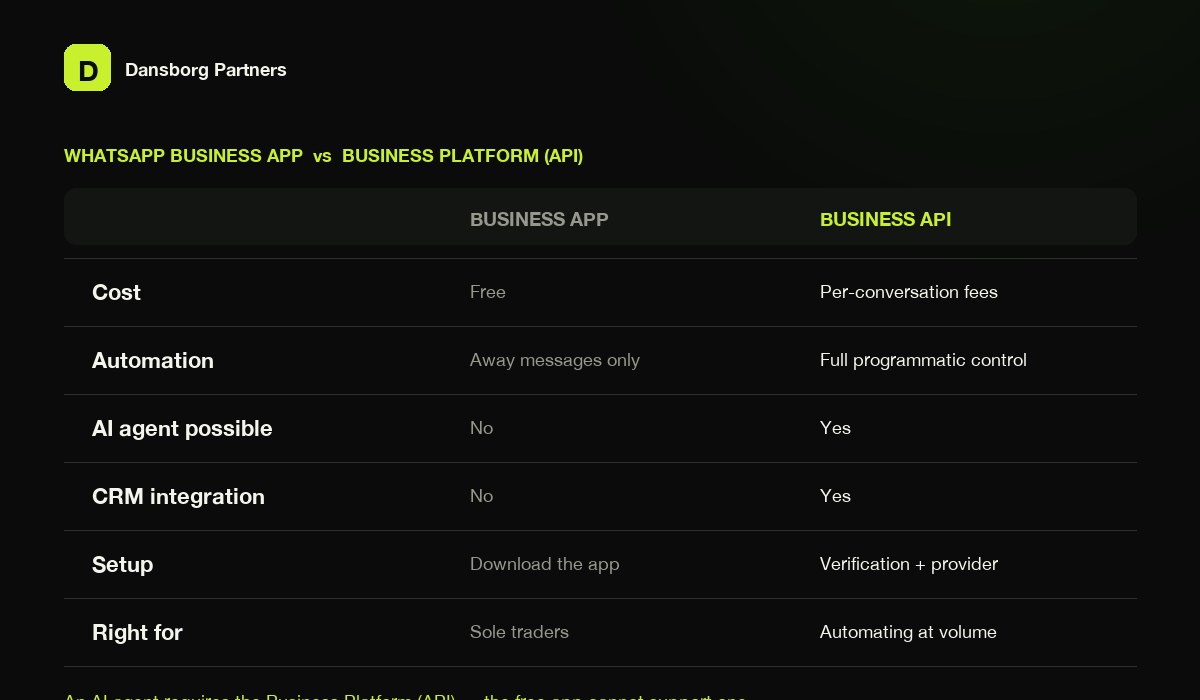
You cannot build a real AI agent on the free Business app. If someone offers to, they are either automating an unofficial client — which risks your number being banned — or they are not building what you think they are. This is the most important thing to understand before taking quotes.
Getting onto the API requires Meta Business verification (business documents, a verified domain, and a number not already registered to the consumer app) plus a provider. Budget 1–3 weeks for this and start it before development — it is the most common cause of a delayed launch.
The 24-hour window — the rule that shapes everything
WhatsApp does not let you message customers freely. Broadly: when a customer messages you, a 24-hour window opens, and inside it you can reply with free-form messages including anything your agent generates. Outside that window you can only send pre-approved templates, submitted to Meta in advance.
Two consequences change how you design the agent. First, your agent is reactive by default — excellent at responding, constrained at initiating. Follow-up sequences must be built from approved templates. Second, template approval takes time and can be rejected. Promotional-sounding templates get rejected more often than transactional ones. Build a template library as part of the project, not two days before launch.
What a WhatsApp AI agent actually does
A realistic build for an Indian SMB routes on intent:
- Question about services or pricing → answers from your own content, and does not assert anything it cannot support.
- New enquiry → asks two or three qualifying questions, writes the lead to your CRM with a summary, routes to the right person.
- Existing customer, order or project status → looks up the record and replies with current status.
- Complaint or negative sentiment → acknowledges, does not attempt to resolve, escalates immediately and flags as priority.
- Outside scope → says so plainly and offers a callback.
The complaint branch matters most and gets built least. An AI agent should never try to resolve a complaint. Customers tolerate a bot answering a pricing question; they do not tolerate one handling their frustration.
What it costs
| Scope | Typical build cost |
|---|---|
| Basic agent — answers from your content, escalates | ₹1,00,000–1,50,000 |
| Connected agent — CRM integration, qualification, routing | ₹1,50,000–2,50,000 |
| Multi-system — CRM, order lookup, payments, multilingual | ₹2,50,000–6,00,000 |
Running costs sit on top: Meta’s per-conversation fees (which vary by category and change periodically — check Meta’s current pricing rather than trusting any figure in an article), your provider’s platform fee, model usage of roughly ₹2,000–25,000 a month depending on volume, and a tuning retainer for the first three months. See the full AI automation cost breakdown for how these compare.
For most Indian SMBs, messaging costs are lower than the equivalent salaried hours — but they scale directly with volume, which salary does not. Model it against your realistic message count before committing.
Where they work well
- Enquiry handling at odd hours. Indian customers message late evenings and Sundays. An agent answering at 10pm on a Saturday converts enquiries that would be gone by Monday.
- Qualification before a human touches it. Your team opens the chat already knowing what is needed.
- Order and project status. Narrow, verifiable, high volume, and the answer comes from a system rather than being generated.
- Multilingual response. Genuinely important in India. An agent replying in the language the customer wrote in — including Hinglish — removes friction an English-only funnel creates. Test it properly; transliterated Hindi is where most implementations get sloppy.
- Appointment booking. Check calendar, offer slots, confirm, send a reminder template.
Where they do not
- Complaints and disputes. Escalate. Always.
- Negotiation and pricing exceptions. Quote published prices, hand off for anything else.
- Emotionally loaded conversations. Medical, legal, financial distress — route to a person immediately.
- Anything where being wrong is expensive. If a wrong answer creates a liability, put a human in the loop.
The mistakes that cause real damage
- Not saying it is an AI. Disclose it in the first message. Customers are fine with a bot that says it is a bot; they are not fine with discovering it.
- No escape hatch. Every conversation needs an obvious route to a person. A customer trapped in a loop with a bot is a customer you have lost.
- Letting it improvise prices. An invented number in writing on WhatsApp is a commitment you will have to argue your way out of.
- Ignoring template rules. Sending promotional content as utility templates risks quality-rating drops, messaging limits and eventually restrictions.
- Never reading the transcripts. The conversation log is the most valuable output of the whole build — real customer language, real objections, real questions your website does not answer.
Build sequence
- Week 0 — start Meta Business verification. Nothing else finishes without it.
- Week 1 — define scope: which intents are handled, which escalate, what the agent may never say.
- Week 1–2 — organise the source content. If your pricing and service descriptions are scattered, fix that first.
- Week 2–3 — build intent handling, retrieval, escalation and CRM writes.
- Week 3 — write and submit templates. Allow time for rejections.
- Week 4 — internal testing. Deliberately try to break it with ambiguous questions, complaints, price pressure and mixed-language messages.
- Week 5 — soft launch on a portion of traffic with a human watching every conversation.
- Ongoing — read transcripts weekly for the first month, monthly after.
The testing week is the one people skip. It is the one that determines whether this embarrasses you.